Walk into any tattoo studio in 2026 and you will see a waiting list dominated by single-needle work, botanical line drawings, and minimalist animals. Fine line has become the default. It is elegant without trying, delicate without being precious, and it photographs like it was meant for Instagram — which is not an accident. This guide walks through why fine line took over, what it does brilliantly, where it breaks down, and how to translate your idea into a brief that lands the design you actually want.
The Instagram Effect and accessibility
Fine line came into fashion at exactly the right moment: when Instagram made the aesthetics of tattoos as important as the pain or symbolism. An intricate mandala photographed well. A bold traditional piece photographed well. But a fine-line floral wrapped around a wrist? It photographed like the artist had spent weeks designing it for your hand alone. The delicacy and negative space read as intentional, not rushed.
That visual premium was only half the draw. The other half was accessibility. Fine line feels like it requires less commitment than a full sleeve or a large chest piece. A small, precise flower on your ankle or behind your ear does not command the same psychological weight as the same design in bold black. The style opened tattoos to people who wanted something meaningful without the visual drama. First-timers did not feel like they were signing up for a billboard.
That democratisation is why you see fine-line work on Instagram influencers, artists, and people who five years ago would have said "tattoos are not for me." The style erased a whole category of hesitation.
Design archetypes that work
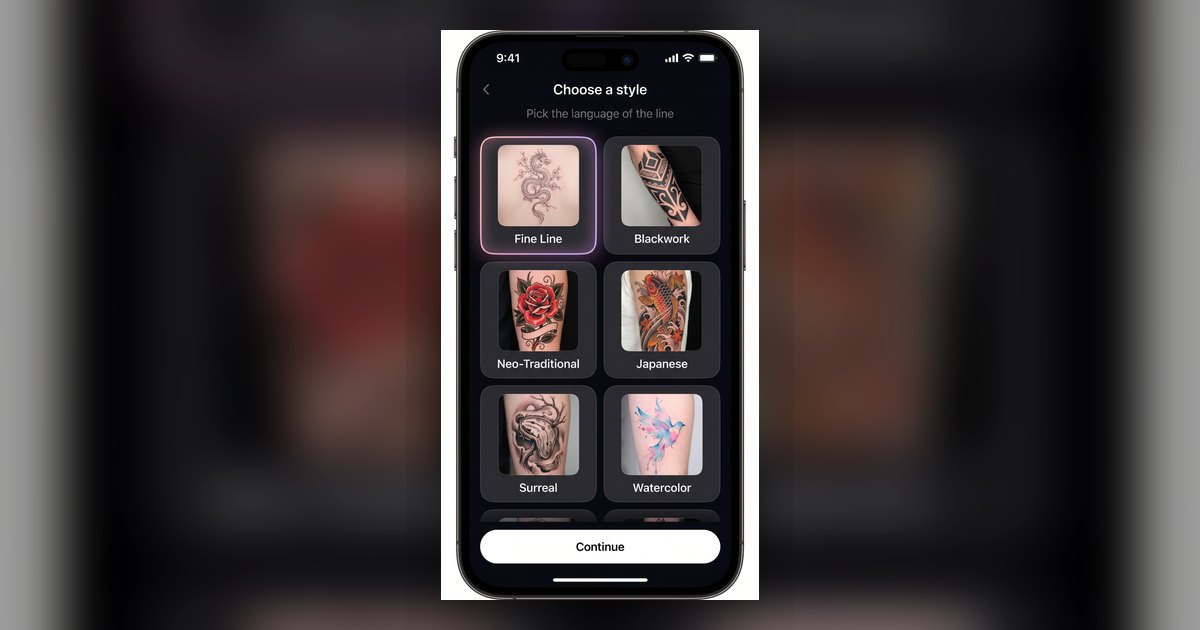
Not every design translates to fine line. The style has a grammar, and the best pieces speak it fluently. Single-needle florals — roses, lotus flowers, small lavender bundles, forget-me-nots — are the foundation. They read as delicate without requiring detail-heavy shading. The negative space around the petals is where the elegance lives. Micro animals also thrive: a fox head, a sleeping cat, a moth. Anything that reads as a silhouette at arm's length works because fine line does not need to shout.
Minimalist linework portraits occupy the middle ground. A face rendered in three or four flowing lines conveys emotion and likeness in a way that feels sketch-like rather than finished. Geometric framing — thin circles, rectangles, or botanical wreaths around a subject — adds structure without visual noise. The frame does the heavy lifting, letting the central figure breathe.
The constraint is the style's superpower. Because fine line cannot rely on bold colour or heavy shading, every line has to earn its place. That discipline produces work that reads as thought-through, not improvised.
Because fine line cannot rely on bold colour or shading, every line has to earn its place.
Where fine line breaks down
Fine line is not forgiving. A hand-poked single needle needs a steady hand and a clear design; anything ambiguous reads as sloppy. Overly ornate details disappear under fine line's weight limits. A complicated mandala with dozens of rings and fills works better in bold black or stippled grey. Text in fine line is especially risky — small letterforms are vulnerable to ink spread, and "meaningful quote" can become illegible within a year.
The other weakness is placement and ageing. Hands, fingers, and areas with high friction wear fine-line ink faster. Line spread is the invisible enemy: as ink migrates slightly under the skin over years, a crisp 0.5mm line blurs into 1.5mm. On the wrist or ankle, where skin is thin and moves constantly, that blur happens faster. A fine-line piece that is sharp and clean at age twenty-three may read as softer and less defined at thirty-five — which some people love, but others regret.
Understand these limits not as dealbreakers, but as constraints that inform the design. A fine-line piece that accounts for potential line spread by building in negative space and avoiding tiny details is a piece that will age beautifully.
How to brief an artist or AI tool
The best fine-line designs are over-specified. Do not just say "flower tattoo." Say: "single-needle rose, black ink, no shading or texture, thin 1–2mm stems, compact silhouette for inside of wrist, keep the bloom facing upward so it reads as growth not wilting." That specificity is not rigid — a good artist will riff on it — but it signals intent and rules out the average.
For AI tools, be even more explicit about line weight, negative space, and aging. Try: "fine-line lavender bunch, single-needle weight, minimal detail in the flower heads, generous negative space between stems, designed for forearm placement where movement will not blur the ink, no shading or cross-hatching, black ink only." If your tool has a placement selector, set it and trust that the render will account for skin curvature and friction zones.
After you generate, look at the output critically. Does the line weight feel consistent? Would you trust a real artist to hand-poke this, or does it have ambiguous passages that would benefit from thicker anchor lines? Does it sit well on the placement? If the AI handed you something with good bones, take it to a human artist for final tweaks — line weight adjustments, placement refinement, aging considerations. That collaboration is where fine line shines.
The scalability across placements
One reason fine line dominates is scalability. The same botanical silhouette works as a micro piece behind your ear, a small wrapped design on the wrist, or a full forearm composition. Bold traditional pieces demand presence; fine line invites intimacy at any size. You can tell the same story across placements without repeating yourself.
That said, placement matters for durability. Wrist, ankle, and finger pieces live in high-friction zones. Sternum and rib placements stretch and compress with breathing; the repetitive micro-motion accelerates ink migration. Behind-the-ear and ribs on flatter skin stay crisp longer. Consider your lifestyle: if you shower, swim, and move through the world with your hands and wrists exposed, a forearm piece will age better than a wrist piece. Frame the design accordingly — thicker anchor lines, more geometric framing, less delicate detail in high-motion zones.
Fine line dominates not because it is trendy, but because it works. It is forgiving enough for first-timers, sophisticated enough for collectors, and scalable across placements and life stages. The constraint of the style — no bold colour, no heavy shading, every line counts — forces thoughtfulness. When you walk in with a brief that respects those constraints, and pair it with a real artist who understands line weight and ink spread, or an AI tool trained on actual tattoo language, you end up with something that reads as intentional, not trendy. That is the entire promise of fine line.